
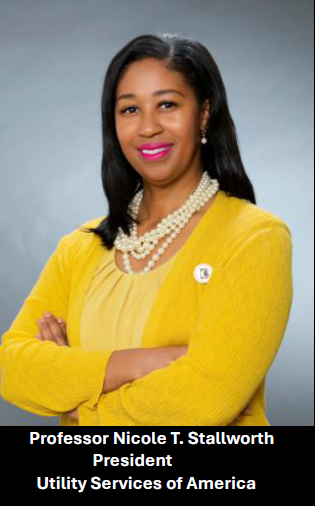
 Professor Nicole T. Stallworth is President of Utility Services of America, a diversified holding company that made its mark as an overhead and underground electric utility contractor. President Stallworth served as the company’s Vice President for 13 years and was a strong advocate for public funding of industry crafts before becoming President in 2017. She is strong proponent of advancing innovative operational practices that improve electric distribution line clearance “line mile” accountability, and the establishment of collaborations that provide trimming around electric service drops in exchange for tree removals near distribution lines.
She has a Master’s Degree in Public Administration and a Bachelor of Science Degree in Finance from Central Michigan University. Before entering the utility sector Professor Stallworth served as a Project Administrator for Electronic Data Systems, a Public Works and Budget Analyst for the Wayne County Commission, and as a Chief of Staff in the Michigan House of Representatives. Professor Stallworth also taught Science and Mathematics at the Science Engineering Mathematics Academy (SEMA) of Wayne State University and a strong advocate for engineering design and construction apprenticeships.
She has served as a Board Member and a licensed large line commercial insurance broker for Lord’s, Dean of Administration for the Foundation Institute for Leadership Development & Career Advancement; is Founder of Healthy Empowered Women and currently as CEO of the Black Caucus Foundation of Michigan.
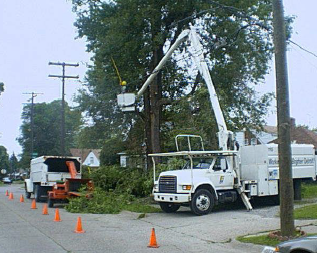
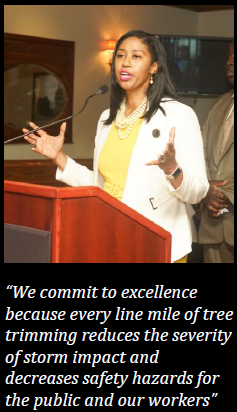
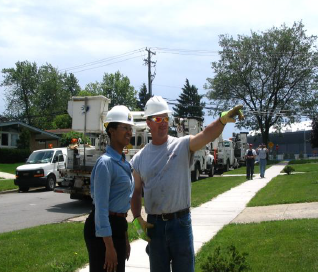
 A professional trainer, Professor Stallworth has created numerous training modules and professional development tools, evaluation processes and rubrics. In 2008 she strongly advocated for a National Utility Training Trust Fund as well as the successful location of a Midwest Regional Training Center in Metro-Detroit. A Workforce Development Specialist, Professor Stallworth has created and implemented numerous skill development and “on ramping” programs to help employers and trade unions identify, recruit, train and retain local and diverse talent. She has extensive experience in helping employers establish behavioral health supports and cultural competency tools to improve workforce time and attendance, team communication, pride in performance, self-critique and evaluation.
Professor Stallworth has extensive experience in organizing Minority-controlled joint ventures and project supply chain strategies. She is also an accomplished construction project community outreach and benefit strategist.
She prides herself on the ability to assist local governments, real estate developers, and large construction project contract owners in the development of ‘Responsiveness and Inclusion Strategies” to both educate the public about the value of a given project as well as provide access and opportunity for comment or input within a timeline that creates mutual trust and affords affirmative progress.
 The rapid retirement of America’s skilled trade workforce in the energy sector is a critical quality of life issue for the nation. The 78 million individuals born between 1946 and 1964 whom comprise the “Baby Boom Generation” are almost 45% of the workforce in general, and close to 70% of the skilled energy trades workforce. Thus, while the Michigan Public Service Commission, the Legislature, and Governor contemplate policy approaches to assure electric service reliability and rapid storm response; it is imperative that they also give strong consideration to assisting DTE Energy, Consumers Power and companies like ours in managing the looming electric linemen retirement crisis.
Electric line workers are the “backbone” of our industry and perform the labor required to operate and maintain the electric grid. They erect transmission towers, utility poles and construct and repair the transmission lines that carry electricity from the power plant to distribution lines; and ultimately to commercial, industrial and residential customers. With a mere estimated 50,000 electric power line workers across the country; along with being one of the most dangerous, it is among the highest paid professions around the globe that does not require a college education. DTE Energy has an estimated 1,500 such tradesmen, Consumers Power has an estimated 500, while contracting companies like ours have a mere 75.
In Michigan, an estimated 40% of the line worker labor force will approach retirement within 3 to 5 years. Just as Michigan’s legislative process has suffered as a result of the loss of institutional knowledge caused by term limits; so too is Michigan’s electric industry now threatened by the potential inability to create a training bridge and mentoring infrastructure for new entrants in the energy trades.
According to a recent Energy Policy Act Report to Congress; the national estimated shortage of line workers exceeds 10,000. According to the report the shortage of qualified candidates “could eventually limit the nation’s ability to maintain and or increase electricity supply, potentially impacting the economic and national security of the United States.”
While national politics is focused on investment in efficient energy generation, it behooves Michigan to aggressively stake out a position as a national training ground for not only electric line workers, but all of the emerging energy trades by targeting investment in the 09-10 budget year for supporting the creation of an Energy Trades Institute. By staking out a leadership position as America’s leader in pre-apprentice and energy skilled trades training, Michigan sets the stage to make a compelling case for federal funding within the Stimulus Appropriation and beyond to assist in addressing this national labor shortage and creating a skilled trade opportunity that could re-train a highly skilled unemployed Michigan
workforce and create thousands of new high wage jobs.
We don’t have to wait on technology advances to create high wage energy sector jobs. All we need is focused leadership determined to support a public-private, organized labor job collaborative aimed at placing job training resources where then can produce an immediate result.
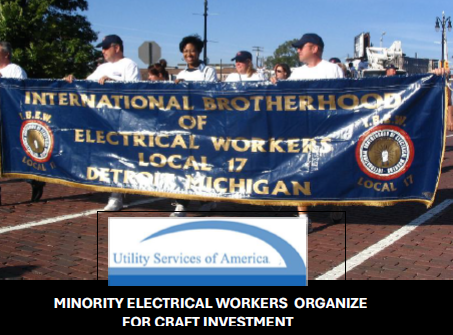 Detroit- In an effort to bring attention to the employment opportunities available to Michigan residents as a result of the expanding energy trades sector; members of Local 17 & 58 of the International Brotherhood of Electrical Workers are supporting an initiative to create a pre-apprenticeship program and an Energy Trades Institute in Michigan.
“The recent storms that we experienced in Southeastern Michigan have created a lot of public awareness around the value of line workers”, said Local 17 Vice President Lamar Williams. “While the public’s attention is focused on the importance of electric service reliability, we think it is a good time launch a policy discussion that will address the shortage of electric line workers”.
During the recent storms, line workers from across the mid-west were called in to help with power restoration. Of the nearly 2,200 professional electric linemen in Michigan, approximately 40% are within 3 to 5 years of retirement. A recent issue of Congressional Quarterly called America’s shortage of journeymen linemen “a national security risk”. Therefore, recruitment and training have become a vital priority. One factor affecting recruitment is the inherent danger associated with the profession. This is a career that demands high quality craft education.
“We believe there is a substantial opportunity for Michigan to be a leader in providing skilled line workers and electricians for existing and emerging energy technologies in the Midwest and throughout the nation”, said Utility Services of America, Civic Affairs Vice President, Nicole Stallworth. “These are exactly the kind of well-paid union jobs that can accelerate Michigan’s economic transformation. With a strong public-private partnership between the utility industry, organized labor and the State, we will be at the forefront of providing skilled workers to meet all energy sector needs.”
“With the advent of alternative energy generation and LED lighting technologies, we believe targeted investments which identify qualified candidates for a pre-apprentice program would substantially enhance the number of electrical craftsmen to handle the massive energy efficiency retrofit work in Michigan’s commercial, retail and industrial sectors”, says Local 58 President Elaine Crawford. “We also believe that enhanced recruitment efforts to bring minorities and women into the trades will play a significant role in urban stabilization efforts”.
The Minority Electrical Worker Caucus has been organized by members of IBEW Locals 17 and 58 to promote diversity in the emerging workforce. “We’re asking our legislators to make creation of skilled electrical trade jobs which meet the expanding capacity needs of the energy sector a priority” says IBEW Local 58 Business Agent Ken Briggs; “and to target job training funds in support of this effort”.
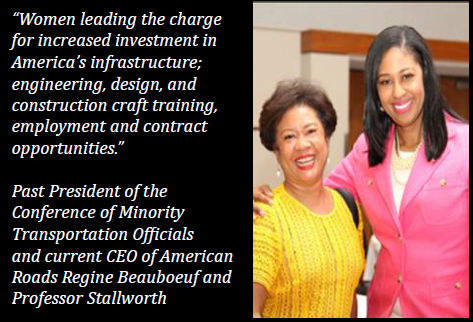
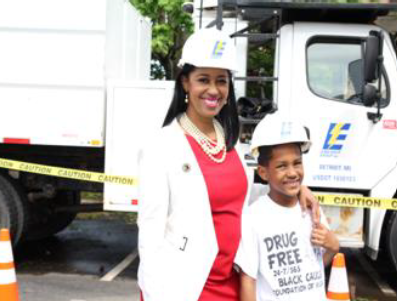
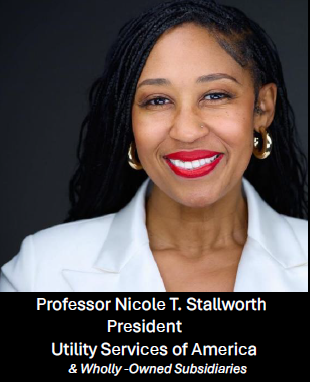 Beyond creating increased shareholder value and expanding the company’s diverse interests, Professor Stallworth is deeply committed to the creation of wellness programs for women professionals, providing inner city children with increased exposure to career opportunities in engineering m design and construction, and expanding opportunities for women and disadvantaged populations to access professional craft opportunities, particularly in the infrastructure trades.
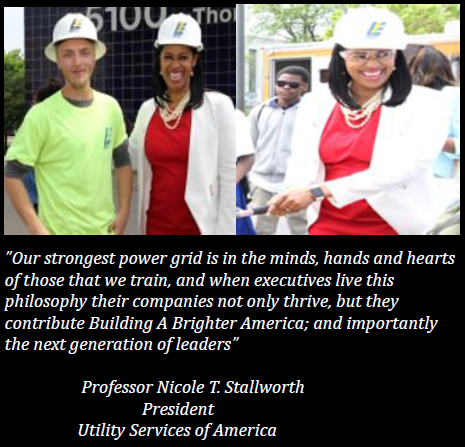
“At Utility Services of America, we strive for excellence because we know service quality produces long-term stable and thriving relationships. A commitment to service is not just a corporate platitude, it is the rent we pay for the space we occupy with our customers, families and the community. We value every opportunity to serve and believe it to be a moral responsibility to serve well as it is central to our purpose. Service is our mission and excellence is our brand.”
Professor Stallworth is on the Board of Directors of Wellington Stallworth a wholly owned subsidiary and married to Utility Services of America founder KB Stallworth. She is Secretary- Treasurer of Florida Sports and Life Skills Institute, a member of Bible-based Fellowship Church, the Alpha Rho Chapter of Alpha Kappa Alpha, has four children and resides in West Bloomfield, Michigan and Wesley Chapel, Florida.Chapel,